


If you’ve been in digital marketing for more than a few years, you know how it feels when the ground shifts beneath you. It happened with my mobile. It happened with voice search. Now it’s happening again — and this time, the shift is deeper and more disruptive than most people realize.
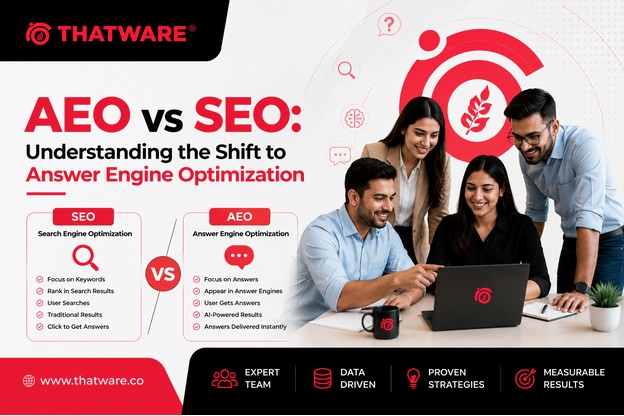
The conversation people keep having is AEO vs SEO — and while it’s tempting to treat it as an either/or debate, the reality is more nuanced, more interesting, and a lot more important to get right.
What SEO Is and Why It Still Matters
Let’s not pretend SEO is dead. It isn’t. Google still processes billions of searches per day, and organic traffic from traditional search remains one of the most cost-effective acquisition channels for countless businesses. Page rankings, domain authority, backlinks, Core Web Vitals — all of that still matters.
But here’s what’s changed: search engines themselves have evolved. Google doesn’t just return ten blue links anymore. It answers questions directly. It generates AI Overviews. It pulls from structured data, knowledge graphs, and third-party sources to serve users a synthesized response — often without requiring a click at all.
That evolution is the bridge between classic SEO and what we now call AEO.
What AEO Actually Is
Answer Engine Optimization is about positioning your content — and your brand — to be the source that AI-powered systems cite when answering questions. Not just Google, but also ChatGPT, Perplexity, Claude, Gemini, Copilot, and whatever comes next.
These aren’t search engines in the traditional sense. They don’t return a ranked list of pages. They synthesize an answer and, in many cases, cite the sources they drew from. Getting cited is the new form of ranking. And optimizing for citation is what AEO is all about.
The methods overlap with SEO in some areas and diverge sharply in others. Good content, clear site structure, and technical health all matter for both. But AEO goes further — into entity optimization, question-based content architecture, off-site authority signals, and a fundamentally different way of thinking about what “showing up” means.
Where They Differ Most
The biggest philosophical difference is the optimization target.
In SEO, you’re optimizing for a ranking algorithm — a system that scores pages against a query and returns a list. The goal is to be at or near the top of that list. Click-through rates, time on page, bounce rates — these are meaningful signals.
In AEO, you’re optimizing for a language model’s judgment of credibility and relevance. The model isn’t ranking pages. It’s deciding whether your content — and your brand — is trustworthy enough to include in an answer. That’s a different standard, and it requires a different approach.
AEO prioritizes: being a recognized, well-connected entity in the knowledge graph; having content that directly, clearly answers specific questions without requiring context from surrounding text; maintaining factual consistency across your web presence; and earning citations in credible third-party sources that LLMs have been trained on or retrieve from.
SEO prioritizes: keyword relevance, domain authority, page experience metrics, and structured backlink profiles. These aren’t irrelevant to AEO — they’re part of a foundation — but they’re not sufficient on their own.
The Practical Implications for Your Strategy
Here’s where it gets concrete. If you’re a brand that wants visibility in both traditional search and AI-powered answer systems, you need to think about both — but you can’t just treat them as identical problems.
Your SEO strategy should continue to address technical health, page speed, structured data, and the content signals that Google’s algorithm rewards. But your AEO layer needs to address: how your brand is represented as an entity across the web, whether your content is structured to be understood and referenced at the passage level, and whether your off-site footprint supports the kind of authority that LLMs recognize.
This is where working with a best Answer Engine Optimization agency becomes valuable. Not every SEO firm understands the entity optimization layer, and not every content agency understands the technical requirements of LLM-compatible content architecture. Finding a partner who can operate across both is genuinely difficult — but genuinely important.
A Concrete Example of the Difference
Say you run a B2B software company that sells project management tools. Under a pure SEO approach, you’d target keywords like “best project management software” with long-form content, comparison pages, and backlink campaigns. You’d try to rank on page one.
Under an AEO approach, you’d also be asking: when someone asks ChatGPT “what’s the best project management tool for remote engineering teams,” does your product get mentioned? If not, why not? Is it because your content doesn’t clearly address that specific use case? Is it because your brand isn’t well-established as an entity in AI knowledge systems? Is it because trusted third-party sources haven’t written about you in a way that LLMs would recognize?
Those are different questions than SEO asks, and they require different answers.
The Bottom Line on AEO vs SEO
The debate is a little bit of a false one. You don’t have to choose. But you do have to expand your thinking.
Brands that treat AEO vs SEO as an either/or question are going to under-optimize one or the other. The smarter frame is: SEO gets you found in traditional search, AEO gets you cited in AI answers. Both matter. Both require investment. And increasingly, they need to be built into a unified content and visibility strategy rather than treated as separate silos.
The shift is real, it’s accelerating, and 2026 is not the year to sit on the sidelines figuring it out. The brands that adapt now will have a meaningful head start on the ones that wait until AEO becomes as mainstream as SEO already is.
That window won’t stay open indefinitely.